Piano Lessons for Adults
Welcome to our Piano Lessons for Adults info page! Our lessons for Adults, whether you are a complete beginner or a returner to piano, are designed to give you the tools to become independent at the piano and to make sure you feel confident in the fundamentals of keyboard technique – as well as basic music theory, sight-reading and chordal accompaniment – while you also learn varied and interesting pieces.
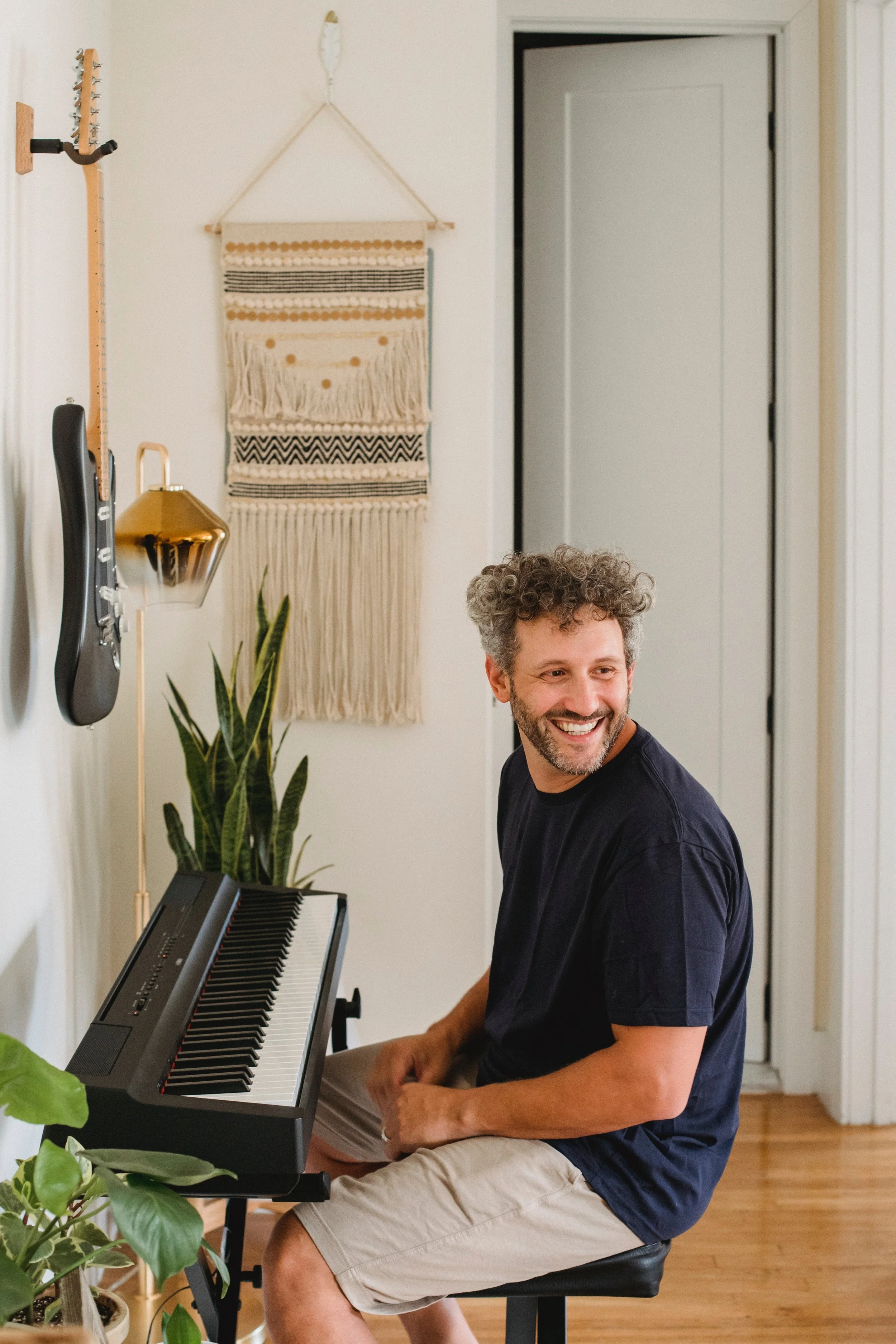
Learn online or sign up for at home lessons! Application form.
We ask you to keep two important things in mind as you begin:
1. The more you put into your lessons, the more you will get out of it.
2. Communicate with your teacher if there is an area you're having difficulty with or something you don't fully understand.
Your teacher is here to help you, so don’t hesitate to approach them if you're having difficulty with anything. Practice is an essential aspect of any music lessons; we all know the phrase ‘practice makes perfect’. Perhaps the most challenging aspect of learning a musical instrument is developing a healthy, productive approach to practice. Your teacher will give you guidelines on how and what to practice, but the real work is up to you, and mostly on your own time.
Here are a few tips:
• Aim to practice every day. Even a small amount of daily practice is much more effective than a long practice session the day before your next class. Make practice a part of your daily routine. Determine when the best time is for you to practice. If you like practicing in the morning, get up 30 minutes early so that you won't be late for work. If you're an evening person, do your practice before going to bed or before you get sleepy.
• Make your practice area comfortable. Is the room well ventilated? Is there proper lighting? Is your mobile switched off or on silent? Make sure that your practice area is comfortable and free from distractions so that you can concentrate when practising. Piano practice time is your time so tell everyone to (kindly) vacate your piano room for 30 minutes, get a nice cup of tea or coffee and have an amazing, productive, positive practice time!
• Practice for at least 20 minutes. Why 20 minutes? We find that this is a manageable time for beginners. Note that 20 minutes refers to work on the course material itself. Devote 5 minutes for warm-ups and 5 minutes for cool downs, just as you would for other physical exercise. That means you should try to set aside at least 30 minutes a day for practice sessions – a reasonable length for most adult students. As your interest and skill level grows, you will find that your daily practice time will also increase.
• Focus on your practice. Effective practice requires concentration and focus. If you are rushing to do it or are distracted by other things that need doing, you won't get much out of it. Try spending a few minutes in silence before you begin in order to take a few deep breaths and clear your head of other concerns.
• Get organised. Practicing the piano efficiently is really about how to organise yourself to get the best results from the effort expended. It’s essential to be very clear about your daily practice objectives. Many students find that writing a daily practice plan helps them to focus on their most important practice tasks and gives them a feeling of accomplishment as they complete each one.
• Work on one task at a time. Discipline yourself to complete each practice goal before moving on to the next. In the long run, you’ll save enormous time by completing the day’s work on one piece or exercise, rather than bouncing back and forth between different ones. While you might not get that new piece note-perfect today, you can indeed ‘finish’ a given passage with musical polish at a slow tempo. For example, work on practising one line of music before moving on to the next.
• Only practice with full concentration. If your practising does not demand full concentration, then you’re not practising properly. Five minutes of concentrated practice is far more valuable than five hours of moving your fingers while your mind wanders. Playing piano is a synthesis of mind, ear and body.
• Always warm up first. Properly warmed-up hands will allow you to accomplish the physical tasks demanded with greater ease and with fewer errors. For example, scales and arpeggios make for great warm-ups.
• Practice slowly. Your brain can’t absorb musical information in detail when playing too fast. It is therefore essential to work slowly and carefully at first. Forcing speed is not a good idea.
• Don’t allow yourself the ‘luxury’ of mistakes. Mistakes cost far too much time to repair and only create uncertainty, whereas your practice ought to build security. Remember, your performance is a direct result of how you practice, and efficient piano practice means playing correctly. If you start making mistakes, it means either that you’re going too fast to learn the music or that your brain is tired. If that’s the case, it’s best to take a break and do something else.
• Practice short passages. The brain absorbs musical information much more readily when it is not overwhelmed by quantity. Each day, practice just one passage, and practice it extremely carefully and thoroughly. This makes for far more efficient piano practice in the long run.
• Keep a practice journal. A practice journal is a log of your practice sessions, including what you practice and for how long. It can be a notebook or even a spreadsheet. I prefer a notebook and my favourite inky pen! At the end of each practice session, write down what you worked on and the time spent on each task. You can also include how you felt during your practice and what kind of emotions were brought up. Do you feel accomplished? Is there something else that’s distracting you from practising? Your wellbeing is just as important for piano practice as for anything else. Or perhaps you have a question you’d like to ask your teacher in the next lesson that you can jot down as a reminder. All great ways to use your practice journal.
Most importantly…
Have fun! Playing piano does involve some hard work, determination and consistent practice, but the joy of playing and making beautiful music and sounds at the piano makes it all worth it. This is what should motivate you to sit down and put in the effort. You will make a lot of mistakes but that’s all part of the learning process! Every wrong note brings you closer to the one you’re looking for. Through learning piano you develop a lot of patience, mindfulness, self-discipline, and confidence. Once you start learning piano, it becomes a part of your identity and your life. It can be such a wonderful way to unwind and enter a different part of your brain that you don’t normally do through other hobbies or work.
The purpose for studying piano is to acquire a skill, an understanding, a disposition to be able to enjoy music through playing and listening - a precious gift for a lifetime.